

Most small companies already have an intranet. It is a shared drive, a pinned email with the holiday calendar, a spreadsheet of extension numbers, and the one person everybody asks where the expense form is. Intranet software fixes that, usually priced per employee per month, with the company's documents on the vendor's servers.
Total CMS can be a small company's intranet instead: a private website on your own server, with the documents, procedures and announcements in one place and a login in front of it. It covers the whole company's day-to-day; the deep product knowledge a sales team leans on is a different job, covered in a company pocket guide.
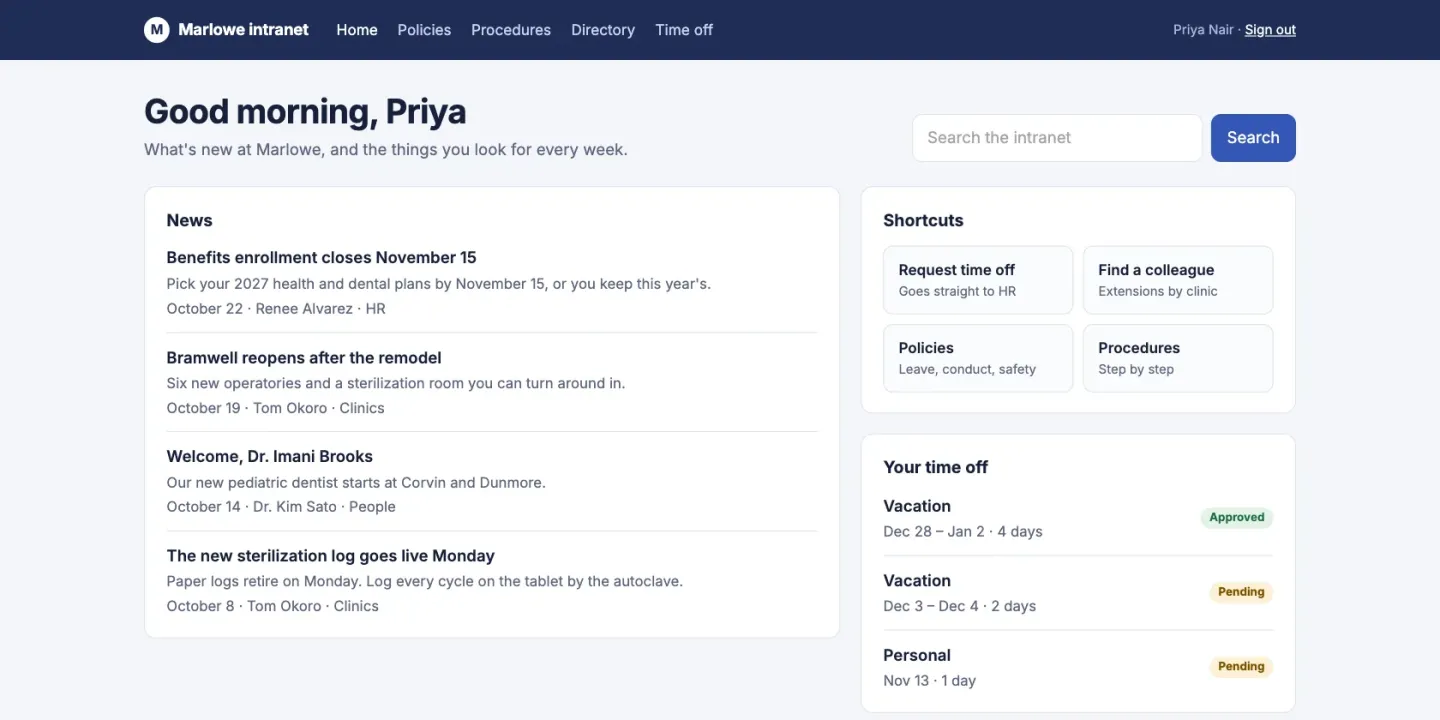
This page's JumpStart builds one for Marlowe Dental Group, a fictional dental group with four clinics and about fifty staff.
A private site behind one login
Total CMS keeps its admin users in the default auth collection. Staff who only read the intranet can go in a separate auth collection, so they sign in to the intranet but never see the dashboard. Staff who also edit go in the default collection, with an access group that limits the admin to the collections they look after.
A Site Builder page can require a signed-in visitor, or membership in a named group, so the whole intranet can sit behind the login, and a page for managers or the finance team only behind its own group. Anyone signed out goes to the staff sign-in and comes back to the page afterwards. In Stacks, Page Lock and Section Lock do the same.
Accounts can expire, which suits a temporary contractor, and password resets are built in.
What goes in it
- Announcements. The built-in blog schema gives you dated posts with a summary, an image and categories. That covers company news, a new starter, and the holiday schedule.
- Documents. Policies, forms and templates in the built-in depot schema, or attached to the page they belong to. A file inherits the access rules of its collection by default, so a link to the staff handbook doesn't open for someone outside the company.
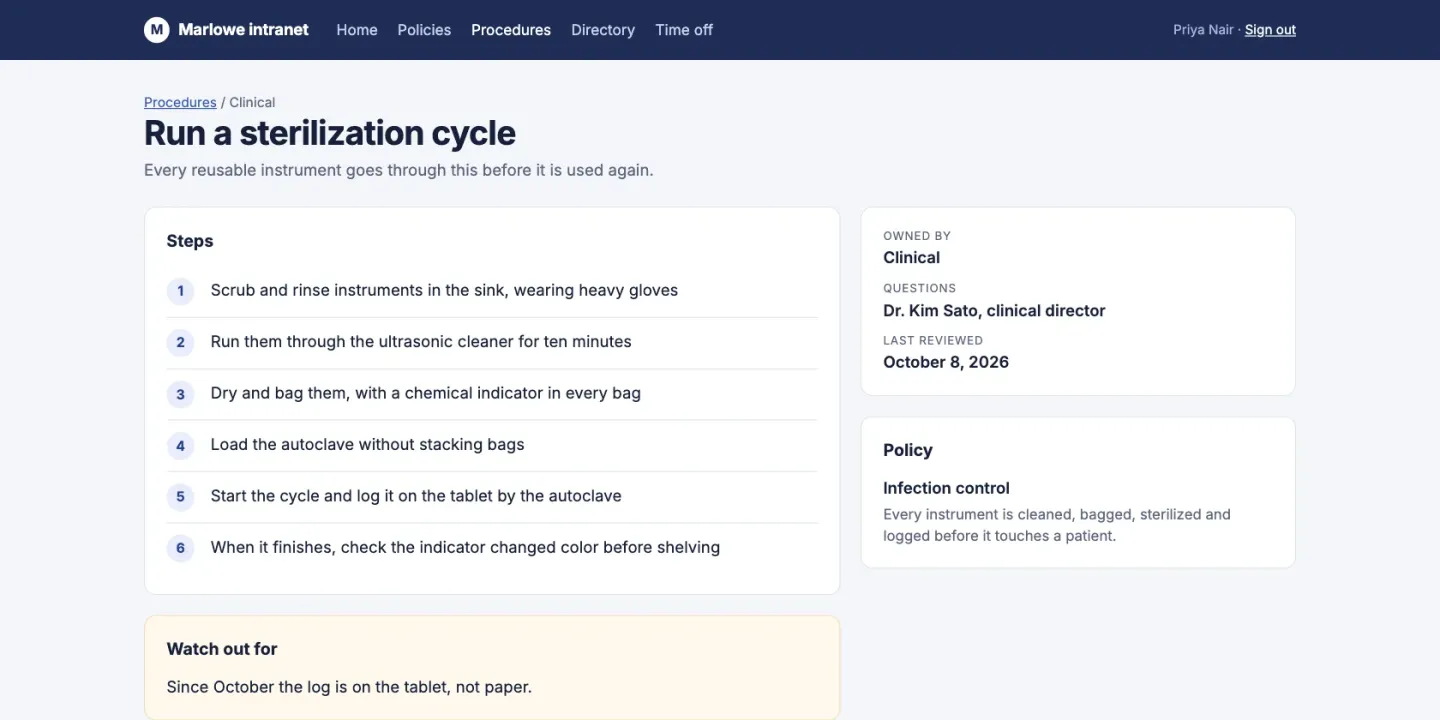
- Procedures and how-tos. On Pro, a procedures collection with the same fields every time: purpose, steps, owner, last reviewed. Each record keeps the version it replaced, so a bad edit can be undone.
- A staff directory. On Pro, a people collection with photo, role, department and extension, sorted and filtered however you like.
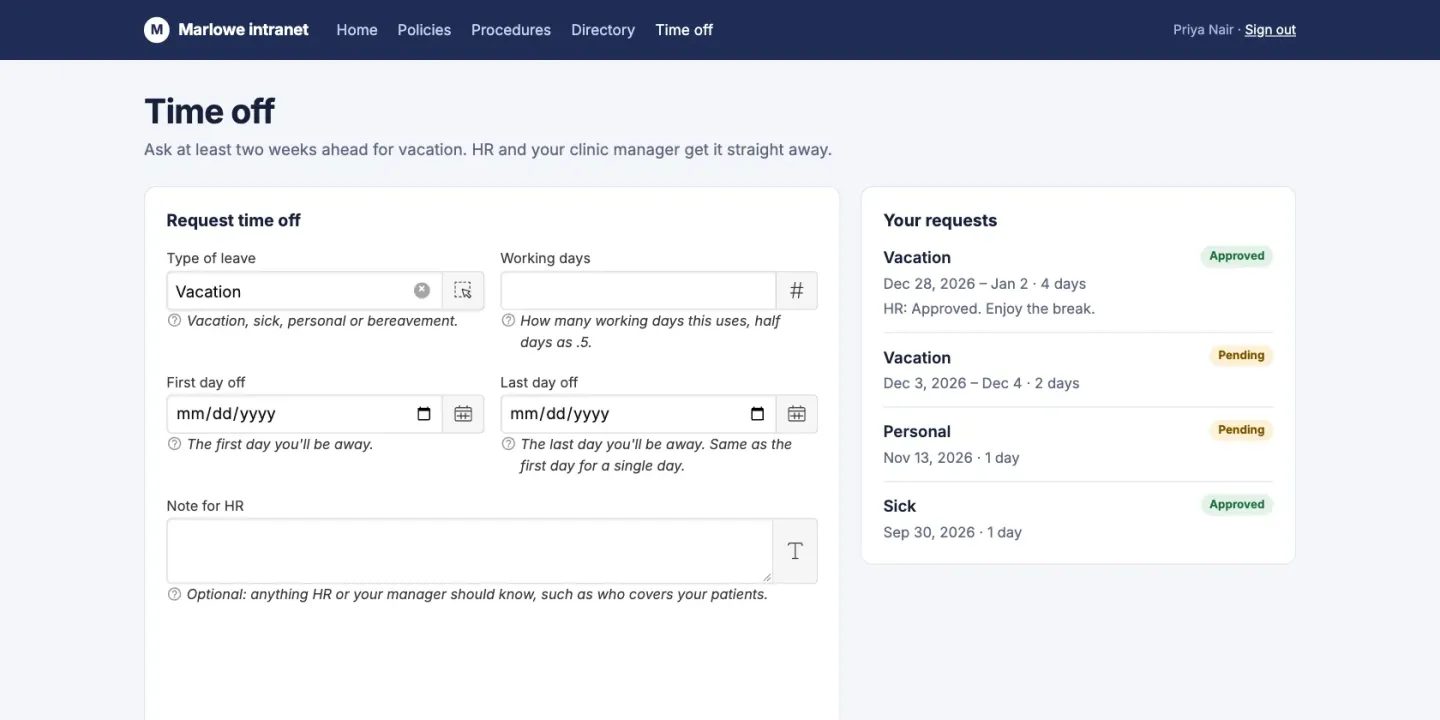
- Forms. On Pro, leave requests, IT tickets and incident reports become forms that save a structured record and email it to the right person, instead of a PDF that gets printed and scanned. Each person sees only their own requests, and only HR can change a request's status.
A search page can look for keywords in the fields you choose to index, one collection at a time.
Owned by the people who know
An intranet goes stale when one person has to update all of it. Access groups let each team keep its own corner current: HR edits the policies, operations edits the procedures, and neither can touch the other's. Total CMS builds the editing form from each schema, so a contributor fills in fields rather than formatting a page.
Where it stops
- It isn't a chat or social tool. There is no messaging, comments, reactions or activity feed. If the point of the intranet is conversation, keep Slack or Teams for that and use Total CMS for the reference material.
- No single sign-on. Staff can't sign in with their Microsoft or Google work account; intranet accounts have their own passwords. A company that needs one directory for every system needs a tool built on its identity provider.
- Search doesn't read inside files. It covers the fields of each record, not the text inside a PDF or Word document. Give each document a good title and description.
- No ready-made modules. There is no org chart, room booking or leave balance tracker out of the box. Each is a collection you design, which is flexible but takes setup.
- Someone has to own the structure. One person should own the schemas and the pages, in-house or a freelancer who builds it and hands it off.
What you need
- Standard covers an intranet built on the built-in blog and depot schemas, with custom auth collections, access groups and locked pages.
- Pro for your own collections (procedures, a staff directory, leave requests and other forms that save a record), and for emailing an announcement to every staff account at once.
- Any host with PHP 8.2 or later, with no database to set up. The whole intranet is plain files on your server, so a backup is a copy of a folder.